
Introduction
Every business creates financial activity from the moment it starts operating. A customer buys a product, a supplier sends a bill, an employee claims an expense, rent is paid, or money moves through a bank account. Each event changes the financial position of the company and must be recorded correctly. In Odoo, these activities can be connected to Accounting through applications such as Sales, Purchase, Inventory, Expenses, Point of Sale, and eCommerce.
Bookkeeping is the system used to capture and organize those activities. It transforms day-to-day transactions into reliable financial records that business owners, managers, accountants, lenders, and tax professionals can understand and use.
Without accurate bookkeeping, a business may still appear
busy and successful while losing control of cash, missing customer payments,
paying vendors late, or making decisions based on incomplete information. Good
bookkeeping creates clarity. It shows what the business earned, what it spent,
what it owns, what it owes, and how much cash is actually available.
This article explains bookkeeping from the ground up. It
covers the purpose of bookkeeping, the main records involved, the difference
between bookkeeping and accounting, a practical business example, and the role
modern software can play as a company grows.
What Is Bookkeeping?
Bookkeeping is the systematic process of recording,
classifying, organizing, and maintaining a business’s financial transactions.
In simple terms, bookkeeping means keeping a complete and
dependable record of the money that enters, leaves, or remains connected to a
business. The records must be accurate enough to explain each transaction and
organized enough to support financial reporting.
Bookkeeping commonly includes:
◆ Recording sales made to customers
◆ Recording purchases from suppliers and service
providers
◆ Tracking customer invoices and outstanding
balances
◆ Tracking vendor bills and payment deadlines
◆ Recording operating expenses and employee
reimbursements
◆ Monitoring cash receipts, bank deposits,
withdrawals, and transfers
◆ Matching payments with the correct invoices or
bills
◆ Reconciling accounting records with bank
statements
A Practical Bookkeeping Example
Consider a small furniture company called Oakline Furnishings. The company sells a dining table to a customer for $1,000 on 30-day credit. The customer will pay later rather than at the time of sale.
A complete bookkeeping record should capture more than the eventual bank deposit. The business needs to record the sale when the invoice is issued, the amount owed by the customer, the customer’s payment when it is received, and the deposit into the bank. If the company maintains inventory records, it may also need to record the cost of the table that was sold.
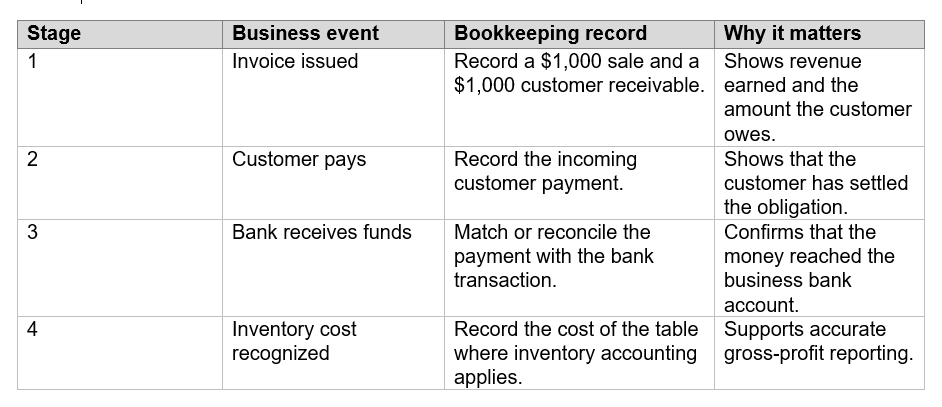
This example demonstrates an important principle: profit, customer debt, and cash are not the same thing. A business can make a sale before receiving the cash. Good bookkeeping keeps these events connected without treating them as one transaction.
What Does a Bookkeeper Record?
A bookkeeper maintains the daily financial records that support the accounting process. The exact responsibilities vary by business, but most bookkeeping work falls into the following areas.
1. Sales and Revenue
Sales are the amounts earned when a business provides
products or services to customers. Depending on the business model, sales may
be paid immediately or invoiced for later payment.
A bookkeeper may record:
⟡ Cash and Credit sales
⟡ Customer invoices
⟡ Discounts and promotional adjustments
⟡ Sales taxes
⟡ Delivery or service charges
⟡ Customer refunds and credit notes
2. Purchases and Vendor Bills
Purchases cover goods and services bought from vendors, such as inventory, equipment, utilities, and subscriptions. When payment is due later, the bookkeeper records the vendor bill, due date, account category, and payment.
3. Operating Expenses
Expenses are the costs incurred while running the business
and generating income. Common examples include rent, salaries, advertising,
fuel, internet, repairs, insurance, bank charges, and professional fees.
Each expense should be recorded under an appropriate
category. This allows management to see which costs are increasing and whether
spending remains aligned with the company’s goals.
4. Customer Payments
A customer invoice and a customer payment are separate
events. A customer may receive an invoice today and pay two or four weeks
later. In Odoo, the bookkeeper can monitor the invoice due date, register the
payment, and then reconcile it with the related bank transaction.
Without reconciliation, an invoice may appear unpaid even after the bank receives the money. Odoo uses outstanding accounts to track registered payments until they are matched with bank transactions.
5. Vendor Payments
Vendor payments must be applied to the correct bills. The
records should show which vendor was paid, which bill was settled, whether the
payment was partial or complete, and which bank or cash account was used.
This helps prevent duplicate payments, missed due dates,
and disagreements with suppliers.
6. Bank and Cash Transactions
All movements through business bank and cash accounts must
be recorded and reviewed. This includes customer receipts, vendor payments,
bank fees, loan payments, cash withdrawals, deposits, and transfers between
accounts.
The accounting records should regularly be compared with
the bank statement. This process is known as bank reconciliation and helps
identify missing, duplicated, or incorrectly recorded transactions.
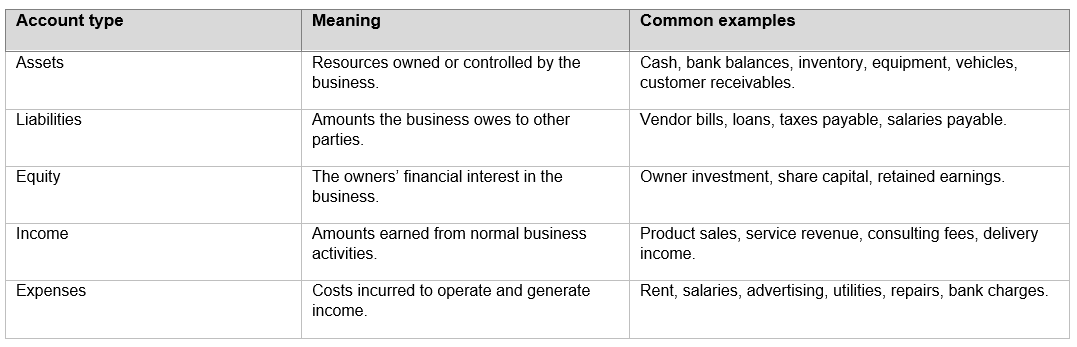
The Five Main Types of Accounts
In Odoo, these broad categories are divided into more detailed account types within the Chart of Accounts.
Bookkeeping and the Accounting Equation
The five account types are connected through the basic accounting equation:
Assets = Liabilities + Equity
For example, a coffee shop buys a $3,000 machine using $1,000 cash and $2,000 supplier credit. The business gains a $3,000 asset, while cash decreases by $1,000 and liabilities increase by $2,000.
• Asset: Coffee machine — $3,000
• Liability: Supplier payable — $2,000
• Owner-funded amount — $1,000
Odoo records these changes through balanced journal entries, keeping the financial records accurate.
What Is Double-Entry Bookkeeping?
Double-entry bookkeeping is the method used by most modern accounting systems. Every financial transaction affects at least two accounts, and the total debits must equal the total credits.
The purpose of double-entry bookkeeping is to preserve the
balance of the accounting records and create a clear explanation of where value
came from and where it went.
For example, when a business pays $500 in office rent from
its bank account:
⟡ Rent expense increases by $500.
⟡ The bank balance decreases by $500.
The same transaction is therefore represented in two
places. One account explains the cost, and the other explains how the cost was
paid.
Business owners do not need to memorize every debit and
credit rule before understanding their reports. However, they should recognize
that complete bookkeeping records both sides of a transaction rather than
recording only cash movement.
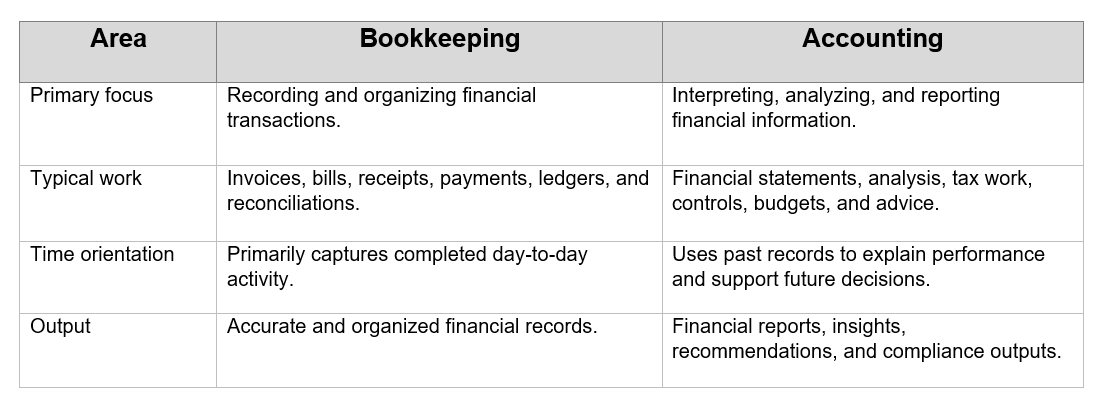
Bookkeeping vs Accounting: What Is the Difference?
Bookkeeping and accounting are closely connected, but they serve different purposes.
Cash-Basis and Accrual-Basis Bookkeeping
Businesses may record income and expenses using different accounting bases. The appropriate method depends on local requirements, company size, industry, and reporting needs.
Cash Basis
Under cash-basis accounting, income is generally
recognized when cash is received and expenses are recognized when cash is paid.
This method may appear simpler, but it can provide limited visibility into
unpaid customer invoices and outstanding vendor obligations.
Accrual Basis
Under accrual-basis accounting, income is generally
recognized when it is earned and expenses are recognized when they are
incurred, even if the related cash movement happens later.
The furniture sale example uses this logic: the company
records the sale and customer receivable when the invoice is posted, then
records the cash settlement when the customer pays.
Why Is Bookkeeping Important?
Bookkeeping is not only an administrative obligation. It is a management system that gives decision-makers access to dependable financial information.
I. It Shows Where Money Comes From and Where It Goes
A bank balance alone cannot explain business performance.
The balance may include customer deposits, loan proceeds, unpaid obligations,
or money reserved for taxes. Bookkeeping provides the details behind the
number.
II. It Helps Control Cash Flow
A business can be profitable on paper and still struggle
to pay its bills. This often happens when customers pay slowly while salaries,
rent, taxes, and vendor bills are due immediately.
By tracking receivables, payables, and expected cash
movements, bookkeeping helps management identify potential shortages before
they become urgent.
III. It Improves Customer Collection
Accurate customer records show which invoices are unpaid,
how long they have been outstanding, and whether the customer has made a
partial payment. This allows the business to follow up professionally and
consistently.
IV. It Supports Vendor Relationships
Good bookkeeping helps a company pay vendors on time,
avoid duplicate payments, and resolve account differences quickly. Reliable
payment behavior can strengthen supplier relationships and support better
commercial terms.
V. It Produces Reliable Financial Reports
Reports such as the Profit and Loss Statement, Balance
Sheet, Cash Flow Statement, General Ledger, Aged Receivable, and Aged Payable
all depend on the quality of the underlying records. Odoo Accounting can
generate these reports from posted journal entries and allows users to
investigate the transactions behind many balances.
What Happens When Bookkeeping Is Poorly Managed?
Weak bookkeeping usually creates problems gradually. A
missing receipt or unmatched payment may appear small, but repeated errors can
make the entire financial record unreliable.
Common consequences include:
✲ Unexplained differences between the bank and the
accounting system
✲ Invoices shown as unpaid after payment was
received
✲ Customer payments applied to the wrong invoices
✲ Duplicate or missing transactions
✲ Late or duplicated vendor payments
✲ Incorrect profit calculations
✲ Unreliable tax figures
✲ Cash-flow surprises
Where Odoo Fits into Modern Bookkeeping
Odoo is an integrated business management platform that
can connect accounting with Sales, Purchase, Inventory, Expenses, Point of
Sale, eCommerce, Projects, and other operational areas.
Instead of entering the same information into separate
systems, a business can connect operational documents with its bookkeeping
process. For example:
✦ A confirmed sales process can lead to a customer
invoice.
✦ A purchasing process can lead to a vendor bill.
✦ Customer and vendor payments can be matched with
open documents.
✦ Bank transactions can be imported and
reconciled.
✦Posted accounting transactions can update financial reports.
Odoo should not be treated as a substitute for bookkeeping knowledge. Its value comes from combining sound accounting practices with connected business workflows and appropriate automation.
Conclusion
Bookkeeping is the financial foundation of a well-managed
business. It provides the records needed to understand income, expenses, cash
flow, customer balances, vendor obligations, assets, liabilities, and
profitability.
Strong bookkeeping does more than support tax preparation.
It improves cash control, strengthens customer and vendor management, enables
reliable reporting, and gives decision-makers confidence in the numbers they
use.
As a business grows, connected accounting software can reduce repetitive work and improve visibility. The technology is most effective when it is built on clear processes, accurate account structures, disciplined reconciliations, and regular financial review.