
Introduction
Once the Chart of Accounts is structured, Odoo uses journals to organize transactions such as invoices, bills, bank activity, cash payments, credit-card charges, and adjustments.
Odoo 19 uses Accounting Journals to group transactions by source or purpose, making them easier to track, reconcile, and report. This guide covers the six journal types, their key configuration, and how transactions flow into journal entries and financial reports.
1. What Is an Accounting Journal in Odoo 19?
An accounting journal is a structured record used to organise journal entries that belong to the same type of financial activity. Odoo records financial documents through journal entries, and each journal entry contains individual debit and credit lines known as journal items.
|
Simple distinction Journal = where the transaction is organised. Journal Entry = the complete balanced accounting transaction. Journal Item = each individual debit or credit line inside that entry. |
Because Odoo follows double-entry bookkeeping, the total debits and credits in a journal entry must balance. The journal does not replace the Chart of Accounts; it determines the transaction stream while the accounts determine where the financial values are classified.
2. Where to Find Journals in Odoo 19
To review or configure journals, open the Accounting application and go to Configuration > Journals. Existing journals can be edited from this menu, and new journals can be created when the business needs a separate transaction stream.
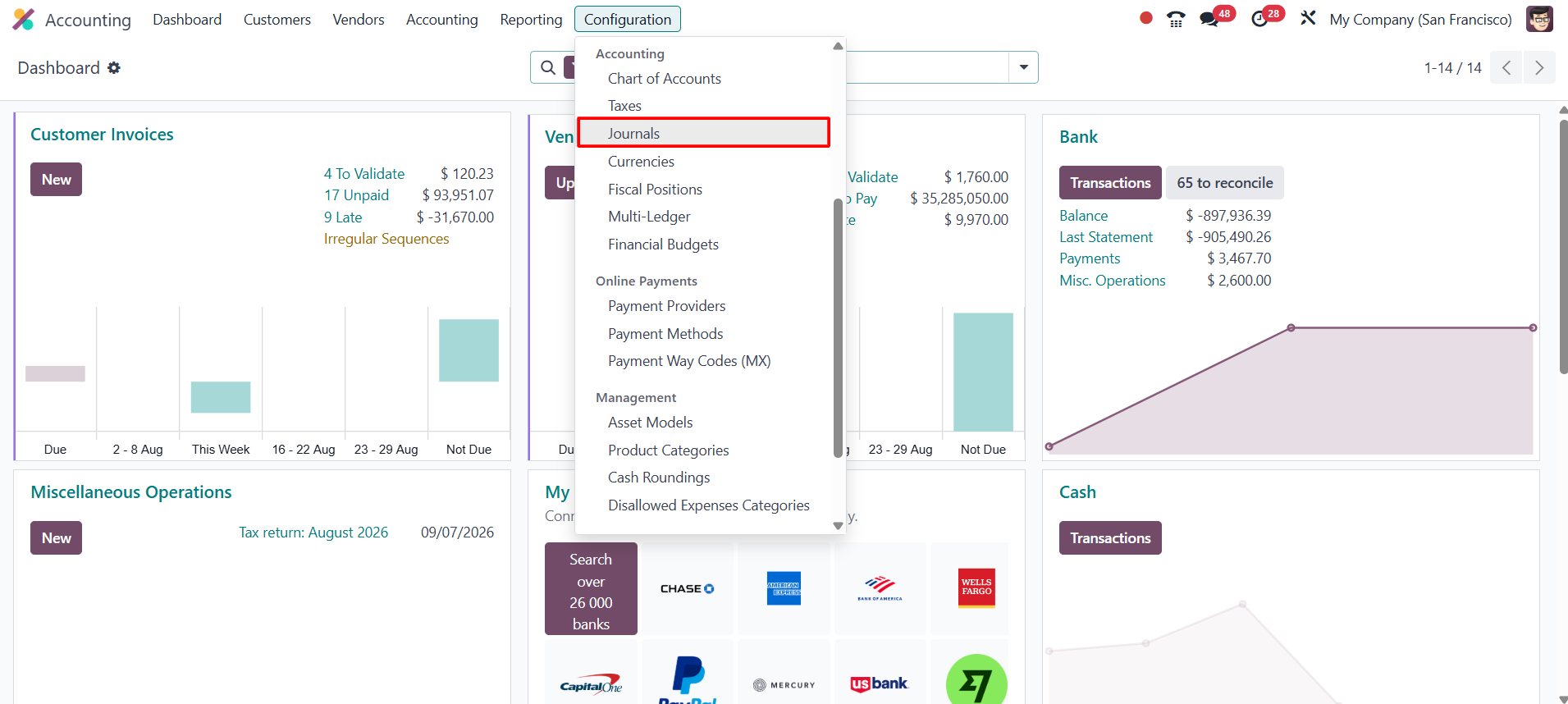
Journals can also be represented by cards on the Accounting Dashboard. A company can have more than one journal of the same type—for example, separate Bank Journals for different bank accounts or separate Sales Journals when management wants distinct invoice sequences or reporting streams.
3. The Six Journal Types in Odoo 19
|
Journal type |
Main purpose |
Typical examples |
|
Sales |
Customer invoices and customer credit/debit notes. |
Customer invoice, service invoice, sales credit note |
|
Purchase |
Vendor bills and vendor credit/debit notes. |
Supplier bill, professional-service bill |
|
Bank |
Bank transactions and related incoming/outgoing payments. |
Customer receipt, supplier payment, bank fee |
|
Cash |
Physical cash transactions and cash-register activity. |
Cash sale, petty-cash payment |
|
Credit Card |
Transactions related to company credit cards. |
Corporate card charge, card repayment workflow |
|
Miscellaneous |
Entries that do not belong to the other journal types. |
Tax closing, accrual, reclassification, manual adjustment |
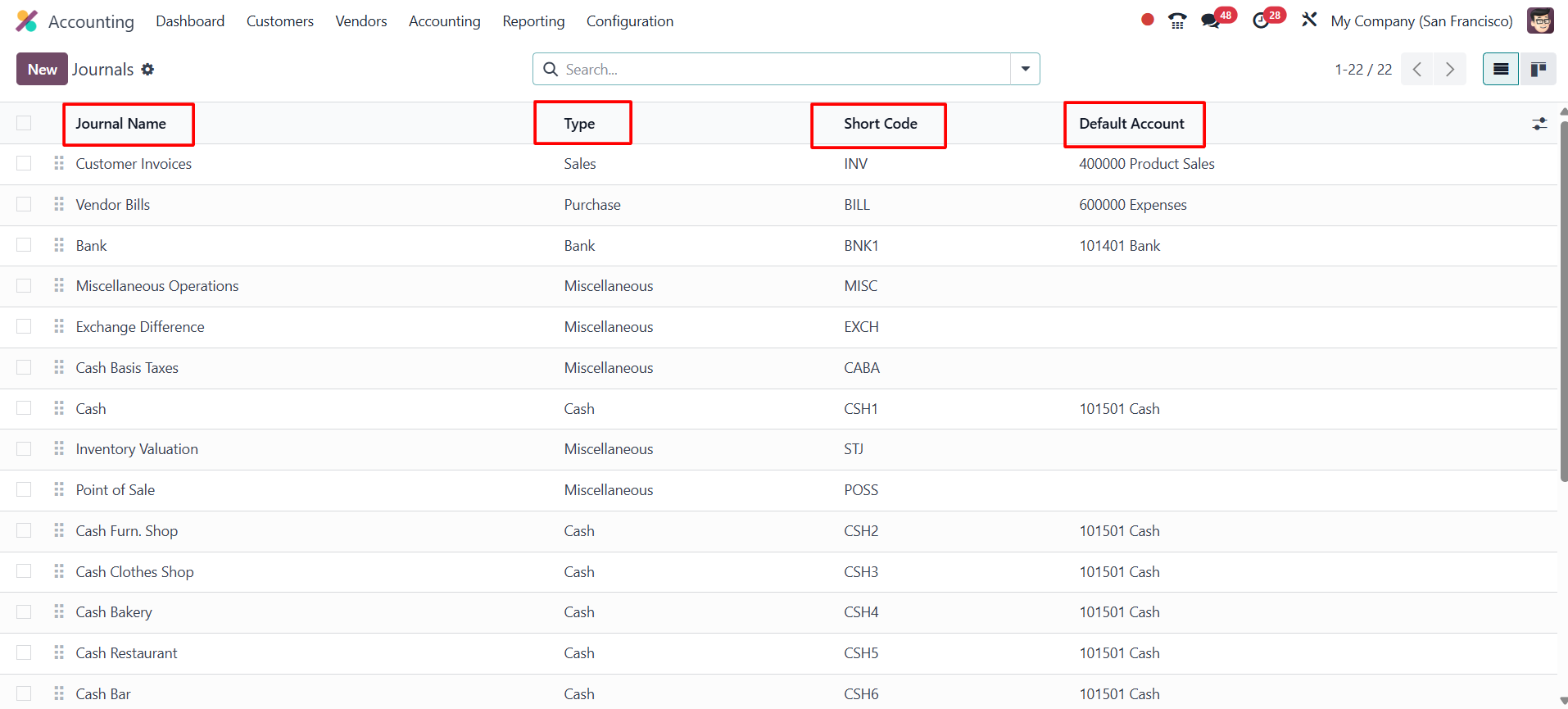
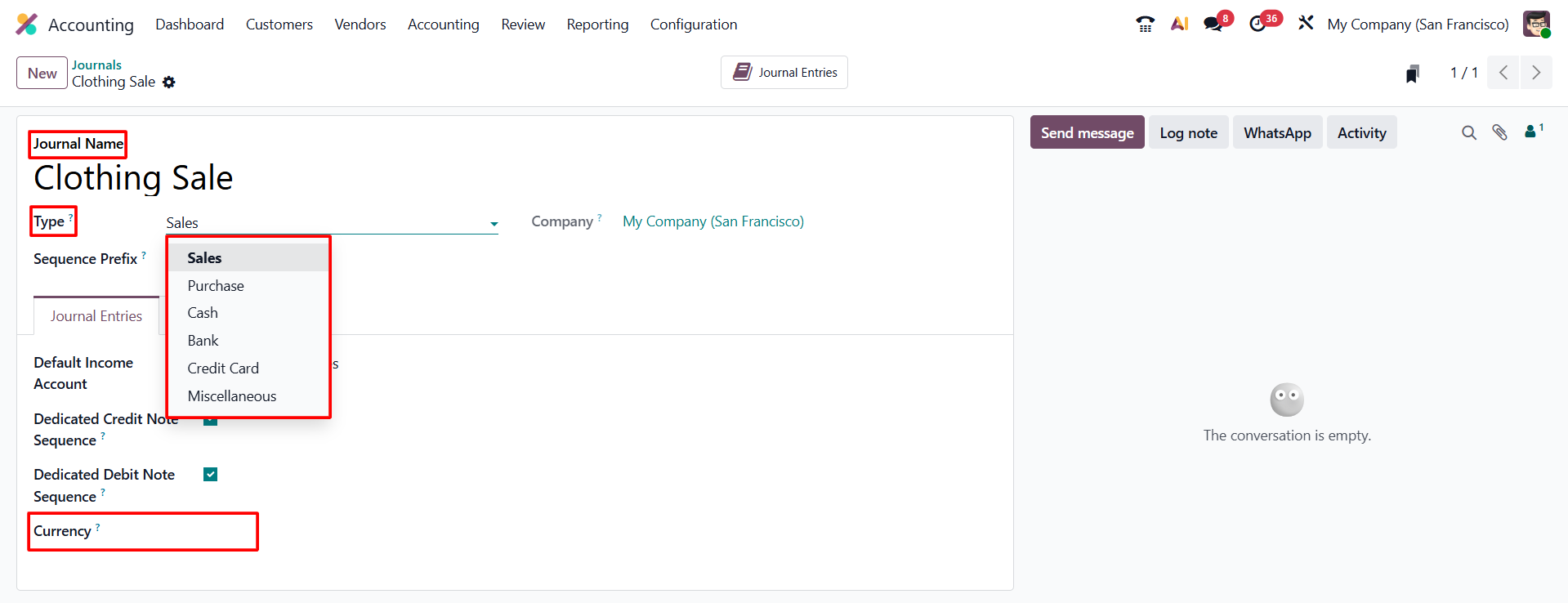
4. Common Journal Settings
Different journal types expose different configuration fields, but several settings are common across the journal structure and are important to understand before creating additional journals.
|
Setting |
Purpose |
|
Journal Name |
Identifies the journal clearly for users, such as Customer Invoices, Vendor Bills, HBL Bank, or Petty Cash. |
|
Type |
Determines whether the journal is Sales, Purchase, Bank, Cash, Credit Card, or Miscellaneous. |
|
Sequence Prefix |
A unique 1–5 character code used as a prefix in journal-entry references. |
|
Currency |
Restricts the journal to a selected currency when required; this field is relevant when multiple currencies are enabled. |
5. Sales Journal
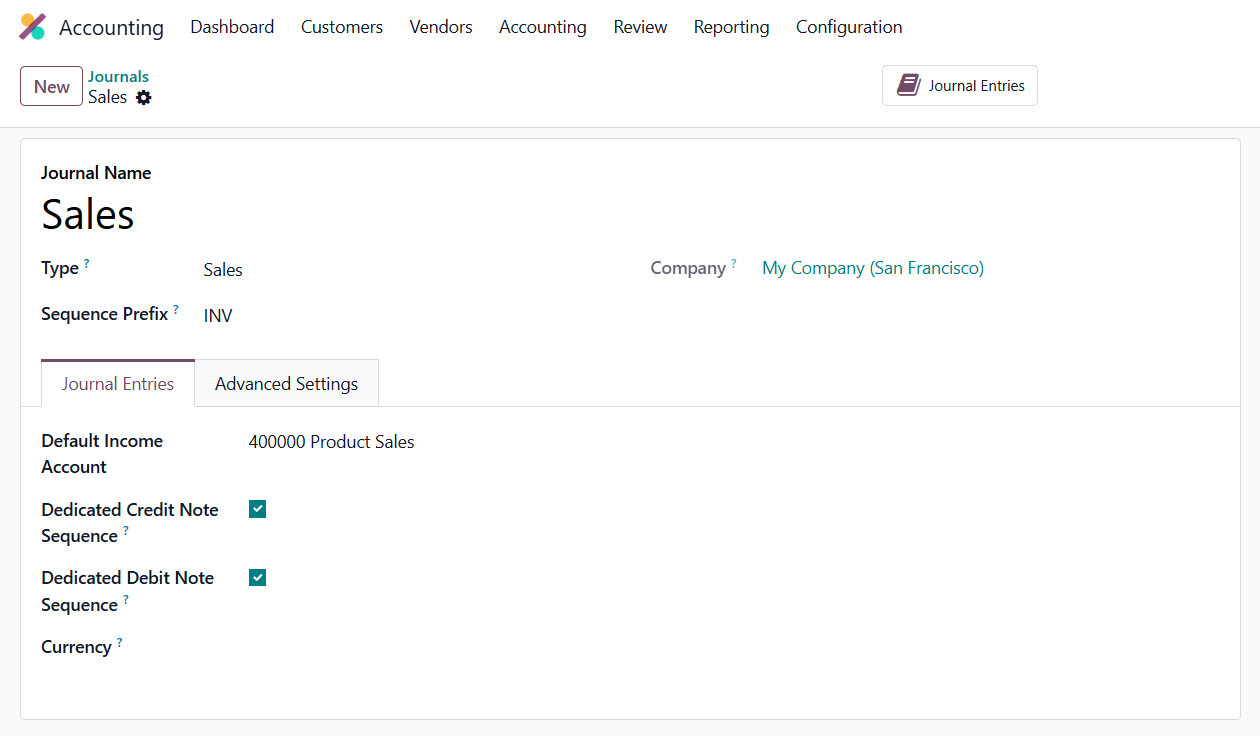
The Sales Journal, also called an income journal, records
journal entries related to customer invoices. When a customer invoice is
posted, Odoo creates the accounting entry in the selected Sales Journal.
A Sales Journal can define a Default Income Account. That
account is used when another income account is not already provided by the
product category, product, or invoice line. The journal can also use dedicated
sequences for credit notes and debit notes so those documents remain clearly
identifiable.
6. Purchase Journal
The Purchase Journal records journal entries related to
vendor bills. When a vendor bill is posted, Odoo uses the selected Purchase
Journal to organise the payable entry and the related expense or asset lines.
`A Purchase Journal can define a Default Expense Account,
which is used when no more specific expense account is supplied by the product
category, product, or expense configuration. Like Sales Journals, Purchase
Journals can also use dedicated credit-note and debit-note sequences.
|
Account |
Debit |
Credit |
|
Professional Fees Expense |
$1,000 |
|
|
Accounts Payable |
$1,000 |
7. Bank Journal
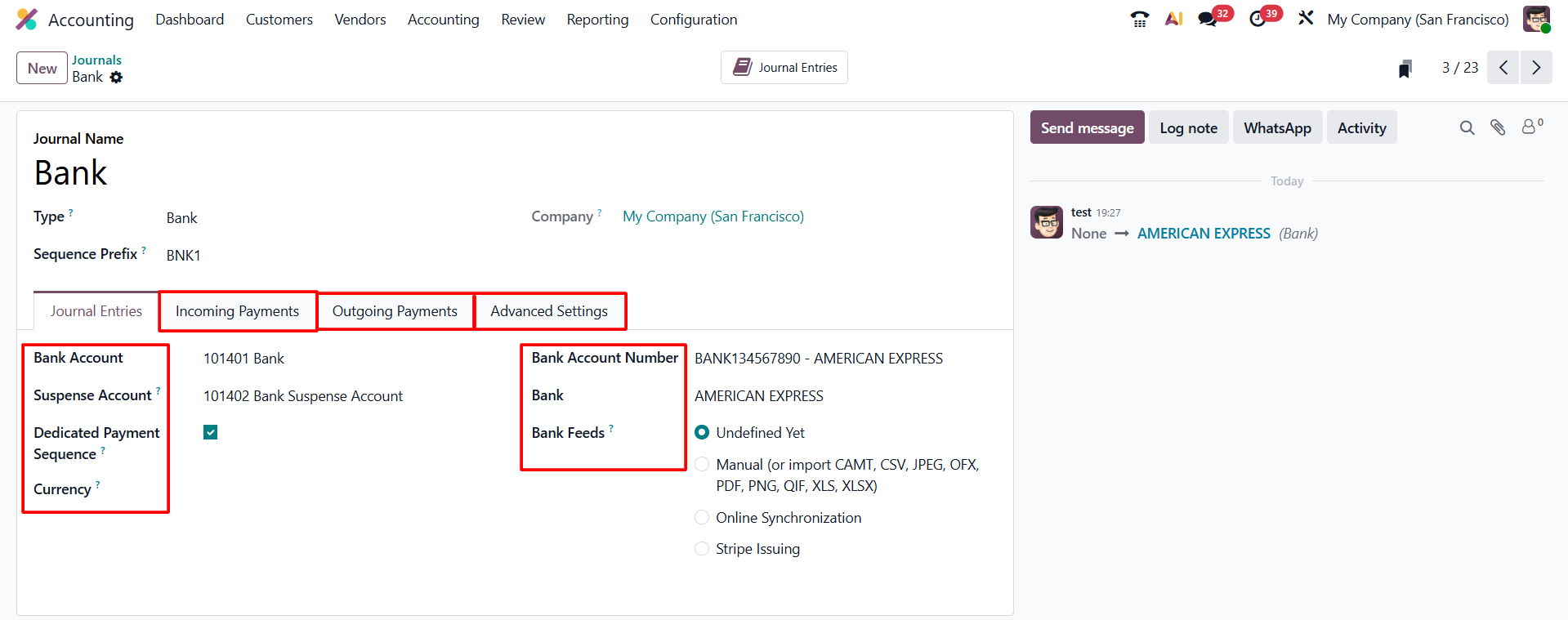
A Bank Journal represents a business bank account and is used to manage bank transactions, incoming and outgoing payments, and reconciliation. Each configured bank account can have its own dedicated journal and related Bank and Cash type account.
Key settings can include the Bank Account, Account Number, Bank, Bank Feeds, Suspense Account, payment methods, and outstanding accounts where applicable.
Transactions can be entered manually or imported through supported online bank synchronization. Unreconciled bank transactions remain in the Suspense Account until they are matched with the correct counterpart during reconciliation.
8. Cash Journal
The Cash Journal records physical cash transactions. It uses a Cash Account as its default account and can also define Profit and Loss accounts for differences between the expected and actual ending cash balance.
|
Cash journal field |
Role |
|
Cash Account |
Default Bank and Cash type account for cash transactions. |
|
Profit Account |
Income or Other Income account used when the cash balance is higher than expected. |
|
Loss Account |
Expense account used when the cash balance is lower than expected. |
Only manual payment methods are available for Cash Journals. This keeps physical-cash processing separate from electronic bank or card activity.
9. Credit Card Journal
Credit Card is a separate journal type in Odoo 19. It is
used to record entries associated with company credit cards and is one of the
important differences from older Odoo journal guides that grouped fewer journal
types.
A Credit Card Journal uses a Credit Card type account as its
default Journal Account. Credit-card transactions can be created manually or
through online synchronisation where supported. Only manual payment methods are
available for Credit Card Journals.
10. Miscellaneous Journal
The Miscellaneous Journal is used for journal entries that
do not naturally belong to Sales, Purchase, Bank, Cash, or Credit Card
journals. Typical examples include tax-closing entries, accruals,
reclassifications, opening or closing adjustments, and other controlled manual
accounting entries.
It should not become the default place for routine
transactions simply because a user is unsure which journal to choose. Normal
customer, vendor, bank, cash, and card transactions should remain in their
appropriate operational journals.
11. Bank, Cash, and Credit Card Journals: Suspense and Outstanding Accounts
Bank, Cash, and Credit Card Journals share clearing concepts that help separate a transaction from its final accounting counterpart. A Suspense Account temporarily holds journal transactions until they are reconciled.
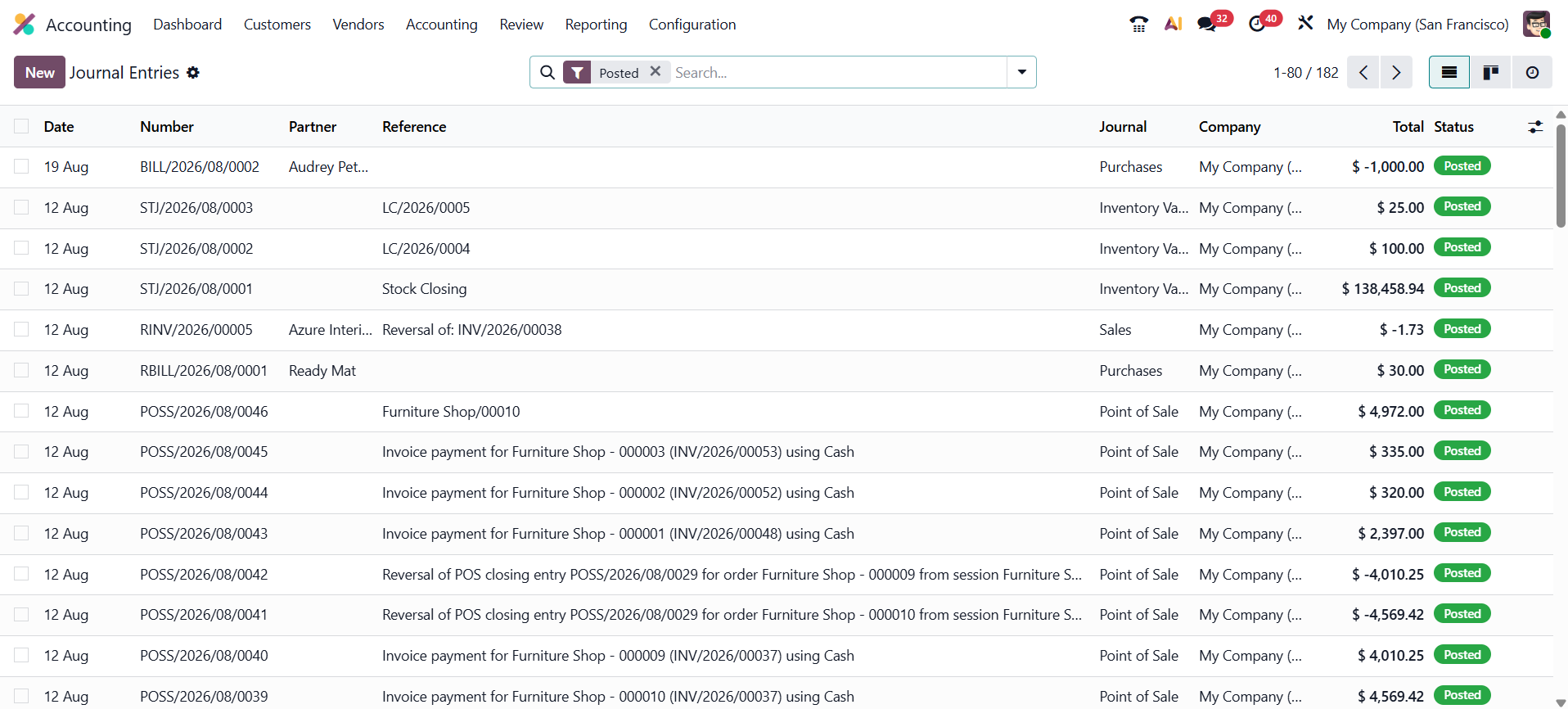
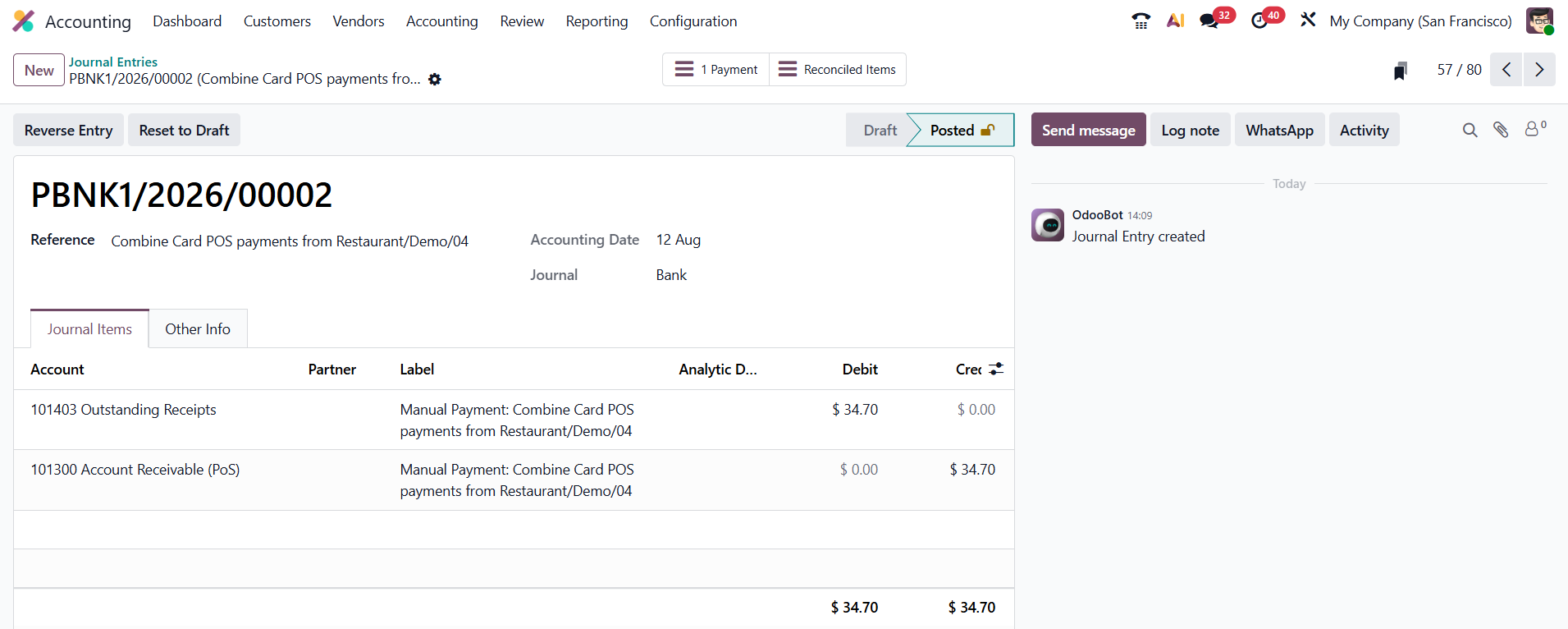
For Bank and Cash Journals, payment methods can also be configured with Outstanding Receipts and Outstanding Payments accounts. When these accounts are used, registered incoming or outgoing payments can create interim journal entries that remain outstanding until the related bank transaction is reconciled.
Accounting Journals organize financial activity in Odoo 19 by separating transactions into clear categories such as Sales, Purchase, Bank, Cash, Credit Card, and Miscellaneous.
A well-configured journal structure improves transaction traceability, reconciliation, and the reliability of financial reports. By choosing the correct journal type and maintaining accurate settings, businesses can keep their accounting records organized and easier to review.
In practice, journals form the link between day-to-day business transactions and the final accounting records that appear in Odoo’s financial reports.