Introduction
Every financial transaction in a business eventually needs a clear accounting destination. A customer invoice must reach a receivable and income account. A vendor bill must reach an expense or asset account. A bank payment must affect the correct bank balance. If those destinations are not organised properly, the business may still record transactions, but its Balance Sheet and Profit & Loss report become much harder to trust.
This is why the Chart of Accounts is one of the first accounting structures a business needs to understand in Odoo 19. It acts as the organised framework behind the general ledger: every account has a purpose, every posted journal item is assigned to an account, and the selected account type tells Odoo how that balance should behave and where it should appear in financial reporting.
Odoo 19 normally starts with a country-specific fiscal localisation that installs a standard Chart of Accounts. A company can then review that structure and add or adjust accounts to suit its real operations. The objective is not to create a large number of accounts; it is to create a structure that makes each transaction easy to classify and each financial balance easy to explain.
Rather than covering every account category at once, this guide focuses on two groups that beginners often need to understand early: Assets and Expenses. Both normally increase on the debit side, but they represent very different financial ideas. Assets remain on the Balance Sheet because they provide future value, while expenses appear in the Profit & Loss report because the value has already been consumed in running the business.
1. The Chart of Accounts in Odoo 19
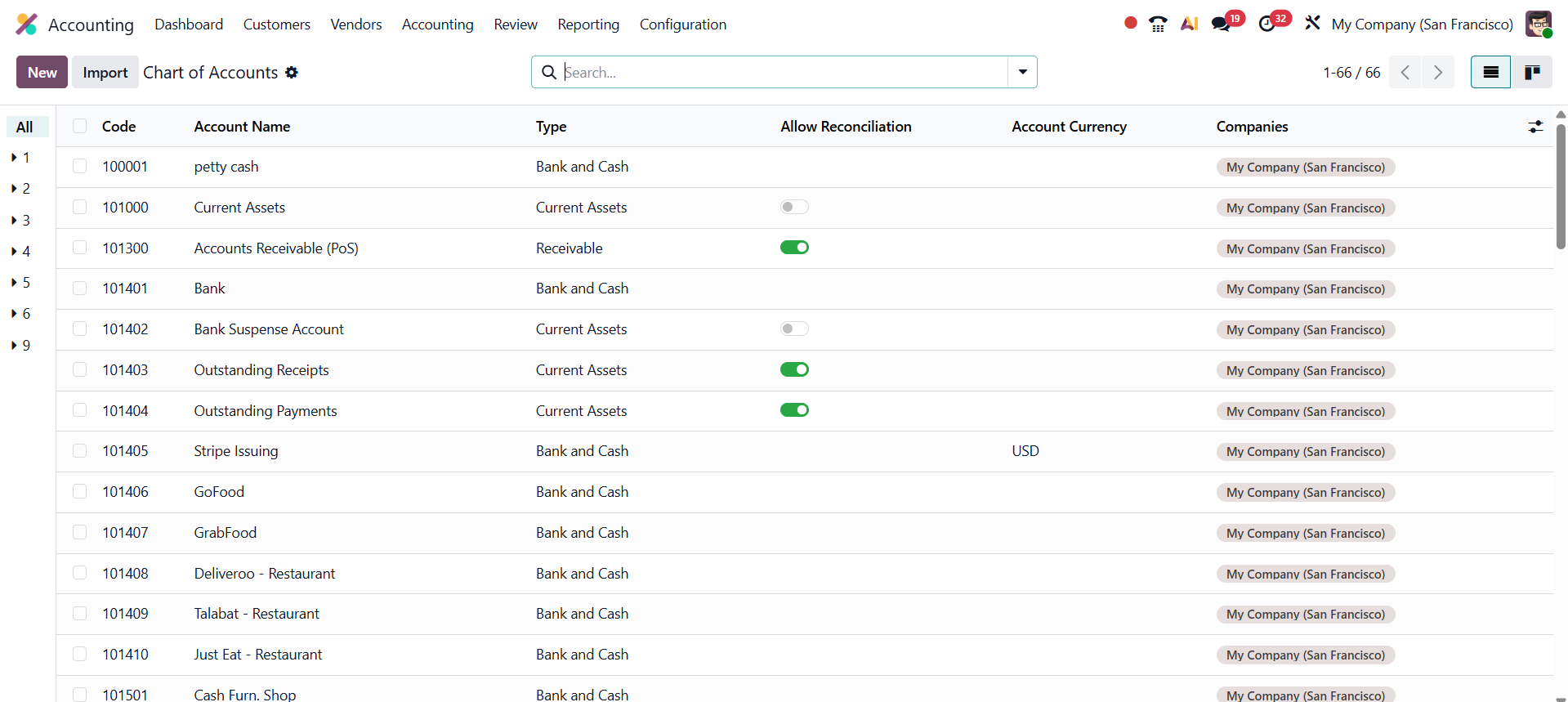
In Odoo 19, the Chart of Accounts is available from Accounting > Configuration > Chart of Accounts. The list brings the company’s ledger accounts into one place so finance users can review, filter, group, create, and maintain them.
The list view makes the structure easy to scan. The most important columns include the account Code, Account Name, Type, Allow Reconciliation, Account Currency, and Company. The Type column is especially important because it controls how Odoo classifies the account for reporting and period-end accounting behavior.
2. Creating or Editing an Account
When a new account is created, the most important decision is not the account name alone. The Type selected for the account determines whether Odoo treats the balance as an asset, expense, liability, equity, income, or another reporting category.
|
Field |
Practical purpose |
|
Code |
A unique identifier that helps organise the Chart of Accounts and locate accounts in reports and journal entries. |
|
Account Name |
A clear description of what the account represents, such as Prepaid Insurance, Office Equipment, or Rent Expense. |
|
Type |
Defines the accounting category and affects how the balance appears in Odoo financial reports. |
|
Default Taxes |
Can propose a tax automatically when this account is used in applicable sales or purchase transactions. |
|
Account Currency |
Restricts the account to a specific currency when required. |
|
Allow Reconciliation |
Allows journal items on the account to be matched and cleared when open-item reconciliation is needed. |
|
Group / Company |
Helps organise accounts and controls the company or reporting structure in which the account is available. |
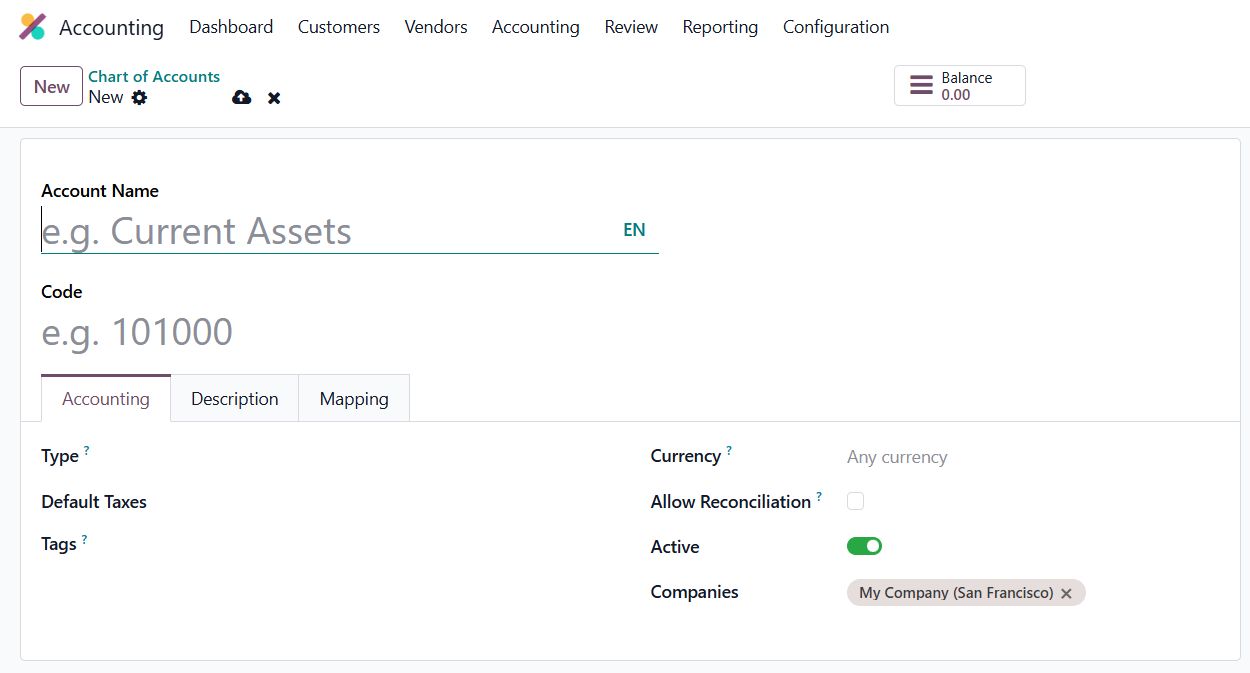
The account name and code make the account easy to identify,
but the Type field determines how Odoo understands the account. Selecting the
wrong type can place a correct amount in the wrong section of the financial
statements.
3. Understanding Account Type: Where Assets and Expenses Fit
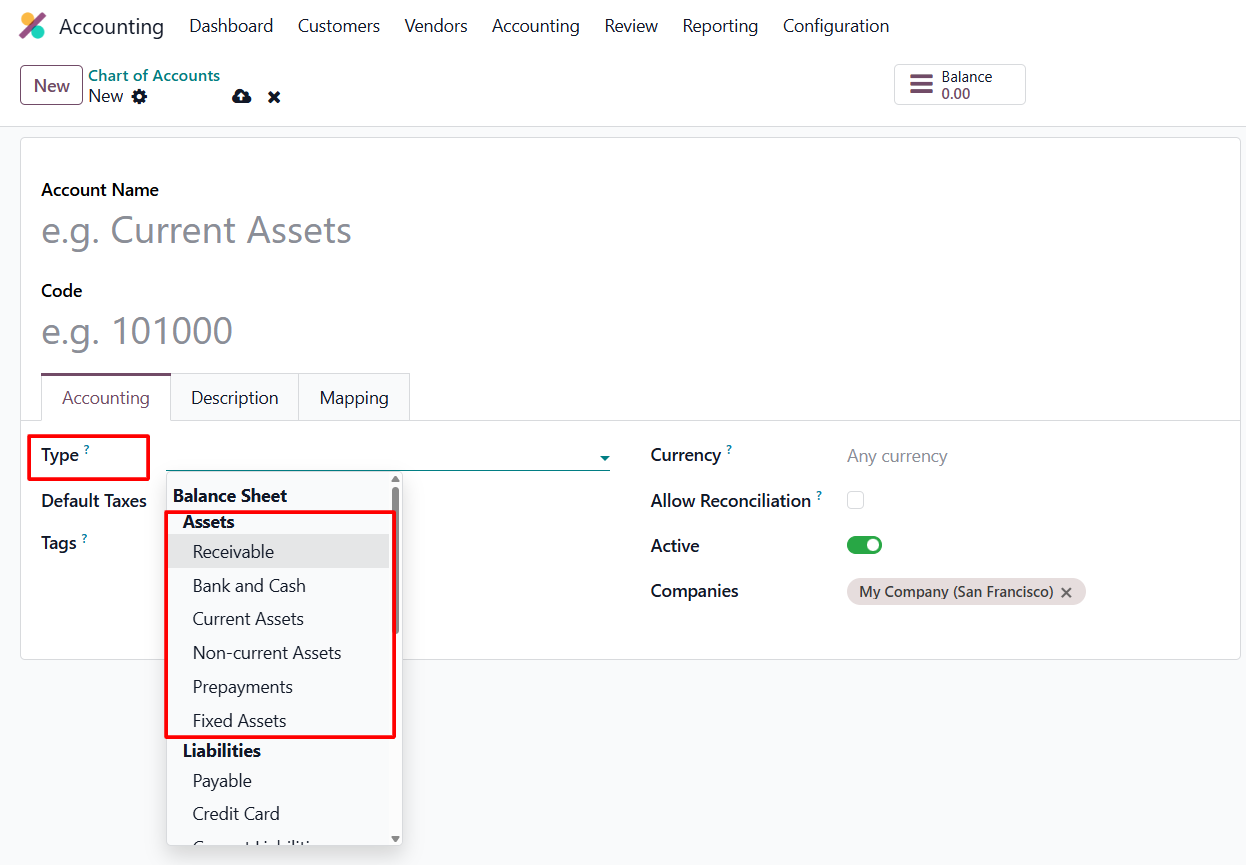
Odoo groups account types according to the financial statement they belong to. Asset accounts sit under the Balance Sheet because they represent resources or future economic benefits. Expense accounts sit under Profit & Loss because they represent costs that have already been consumed in earning revenue or operating the business.
This distinction is central to good accounting. A payment does not automatically mean an expense. A company may pay cash today for something that will benefit future periods, such as annual insurance, a vehicle, machinery, or another long-term resource. In that case, the first entry may belong to an asset account instead of an expense account.
4. Debit and Credit Nature of Assets and Expenses
Assets and expenses normally have a debit nature. This means that their normal balance is on the debit side and, in most ordinary transactions, a debit increases the account while a credit decreases it.
|
Account category |
Increase |
Decrease |
Normal balance |
Main report |
|
Asset |
Debit |
Credit |
Debit |
Balance Sheet |
|
Expense |
Debit |
Credit |
Debit |
Profit & Loss |
The fact that both categories normally increase with a debit does not mean they are the same. The key question is whether the business still controls a future benefit. If the benefit remains for future periods, the amount is generally an asset. If the benefit has already been consumed in the current period, the amount is generally an expense.
|
A simple rule for beginners “Asset” = future value remains with the business. “Expense” = value has been consumed to operate the business or generate revenue. Both normally have debit balances, but they appear in different financial statements. |
5. Asset Account Types in Odoo 19
Odoo 19 provides several asset account types so that businesses can distinguish cash, receivables, short-term resources, prepayments, and long-term assets. Choosing the correct type helps Odoo present the balance in the proper section of the Balance Sheet.
|
Odoo asset type |
Meaning |
Typical example |
|
Receivable |
Money customers owe the business for goods or services already invoiced. |
Customer invoices and open customer balances. |
|
Bank and Cash |
Funds held in company bank accounts or as cash. |
Business bank account, petty cash, main safe. |
|
Current Assets |
Short-term assets expected to be converted into cash or consumed within roughly one year. |
Inventory-related balances, short-term deposits, clearing assets. |
|
Non-current Assets |
Long-term assets not expected to be converted into cash within the short term. |
Long-term resources that do not fit the fixed-asset category. |
|
Prepayments |
Amounts paid in advance for benefits that will be received in future periods. |
Annual insurance, prepaid rent, prepaid software subscription. |
|
Fixed Assets |
Tangible long-term resources used in business operations and normally depreciated over time. |
Vehicles, machinery, furniture, equipment. |
Asset accounts normally carry a debit balance. For example,
when a company purchases equipment for $5,000 using its bank account, Equipment
is debited because the asset increases, while Bank is credited because cash
decreases.
|
Account |
Debit |
Credit |
|
Equipment / Fixed Asset |
$5,000 |
|
|
Bank |
$5,000 |
6. Expense Accounts in Odoo 19
An expense is a cost that has been consumed in operating the business or generating revenue. Expense accounts appear in the Profit and Loss report and normally increase with a debit and decrease with a credit.
|
Odoo expense type |
What it represents |
Typical examples |
Normal nature |
|
Expenses |
Normal operating costs. |
Rent, utilities, advertising, office supplies, professional fees. |
Debit |
|
Other Expenses |
Costs that are not part of the company's normal operating activity, where the localisation and reporting structure use this classification. |
Non-routine or separately reported expenses. |
Debit |
|
Depreciation |
Periodic recognition of the cost of depreciable assets. |
Vehicle depreciation, equipment depreciation. |
Debit |
|
Cost of Revenue |
Direct costs associated with delivering goods or services. |
Direct material cost, product cost, service-delivery cost. |
Debit |
Practical Example: Monthly Rent
A company pays $800 of office rent from its bank account. Rent is consumed during the period, so it is recorded as an expense.
|
Account |
Debit |
Credit |
|
Rent Expense |
$800 |
|
|
Bank |
$800 |
The expense increases with a debit, while the bank asset decreases with a credit.
7. Practical Example: When an Asset Becomes an Expense
One of the easiest ways to understand the difference between assets and expenses is through a prepayment. Assume a company pays $12,000 for a 12-month insurance policy at the beginning of the year.
On the payment date, the business has not yet consumed the full insurance benefit. The amount therefore begins as a Prepayment asset:
|
Account |
Debit |
Credit |
|
Prepaid Insurance |
$12,000 |
|
|
Bank |
$12,000 |
At the end of the first month, $1,000 of the benefit has been consumed. That portion moves from the Balance Sheet to Profit & Loss:
|
Account |
Debit |
Credit |
|
Insurance Expense |
$1,000 |
|
|
Prepaid Insurance |
$1,000 |
This example shows the relationship clearly: the original
payment is an asset because future benefit remains; each month, part of that
asset becomes an expense as the benefit is used.
8. Fixed Assets and Depreciation
A similar relationship appears with fixed assets. A vehicle, machine, or piece of equipment may provide value for several years, so its cost is normally recorded as an asset first rather than charged completely to expense on the purchase date. Depreciation then recognises part of that cost as an expense over the asset’s useful life.
A typical depreciation entry debits Depreciation Expense and credits Accumulated Depreciation. This also introduces an important exception to the normal asset rule: accumulated depreciation is a contra-asset account and normally carries a credit balance because it reduces the carrying value of the related asset.
|
Account |
Debit |
Credit |
|
Depreciation Expense |
$400 |
|
|
Accumulated Depreciation |
$400 |
Odoo can support asset automation on eligible Fixed Asset
and Non-current Asset accounts, depending on how the account and asset model
are configured. The useful life, depreciation method, threshold, and accounting
treatment should be confirmed by the company’s accountant.
9. How the Account Type Affects Odoo Reports
Selecting the correct Type is essential because Odoo uses the account classification when presenting financial reports.
|
Account category |
Main financial report |
Reporting effect |
|
Asset accounts |
Balance Sheet |
Show resources and balances controlled by the business at a specific date. |
|
Expense accounts |
Profit and Loss |
Show costs recognised during the selected reporting period. |
If an expense is incorrectly configured as an asset, the
Balance Sheet can be overstated and the Profit and Loss can understate
expenses. If a genuine asset is incorrectly posted directly to expense, the
current period may show too much cost and too little asset value.
The Chart of Accounts is not simply a list of names and codes. It is the structure Odoo 19 uses to decide how each financial transaction is classified, reported, and carried forward through the accounting process.
For beginners, understanding Assets and Expenses is an
excellent starting point because both normally increase on the debit side while
serving very different purposes. Assets represent future economic benefit and
remain on the Balance Sheet. Expenses represent value already consumed and
appear in Profit & Loss. Prepayments and depreciation show how amounts can
move from one category to the other over time.
Once these classifications are understood, the next step is
to learn how Accounting Journals use the Chart of Accounts to create balanced
journal entries from customer invoices, vendor bills, bank transactions, and
other business activity.